
Augmentation Over Automation

Every week, we filter the AI chaos to bring you fresh innovation insights and actionable takeaways.
Top Insights
1. Employee perception is surprisingly important in AI strategy
Companies face a strategic crossroads in their use of AI: they can either automate to reduce headcount, or augment employees to drive innovation. Some organizations are already laying off staff, anticipating that AI will replace human labor. However, they fail to realize that an AI strategy is about more than implementing new tools; it effectively signals whether employees have a future within the company.
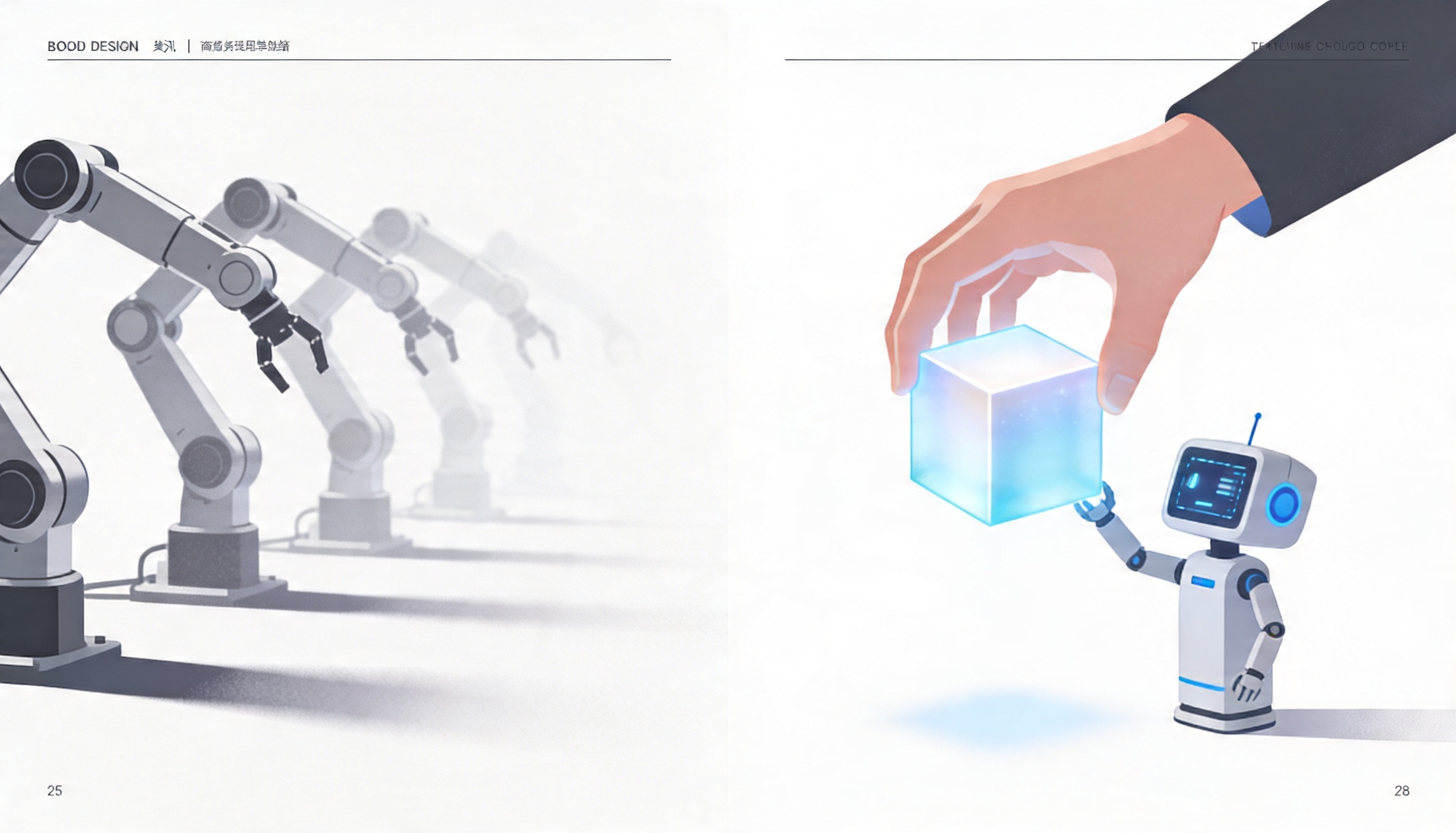
A survey of approximately 1,300 desk workers reveals that 62% believe their companies use AI to augment their capabilities, while 34% believe their organizations use it primarily to automate work. This perception of an automation-first intent is notably higher within the retail and financial services sectors.
A poorly conceived or communicated AI strategy can lead to three significant risks:
Employee anxiety: Concerns regarding layoffs and resulting declines in well-being.
Workflow inefficiencies: Poor integration that leads to “workslop.”
Talent erosion: The displacement of junior employees, which weakens the long-term talent pipeline.
Consequently, while an automation-focused strategy may generate quick wins and a short-term performance boost, it often leads to a long-term decline. An augmentation-focused strategy takes the opposite path: it may yield fewer immediate benefits but ultimately fosters sustainable, long-term growth and competitive advantage.
🎯 What to do:
Move KPIs from "Cost-per-unit" or "Task Completion Time" to "Product Velocity" and "Innovation Throughput."
Require that time or operational cost saved via AI deployment must be directly re-budgeted toward R&D for new product lines or customer experience initiatives.
Hire AI-native junior employees and assign them to re-engineer old workflows using AI.
Reference: Why Companies That Choose AI Augmentation Over Automation May Win in the Long Run (HBR)
2. A reconsideration of business model is often needed
AI is changing what customers believe is worth paying for. When work that used to take weeks can now be done in hours, clients stop paying for effort and start questioning value.
Professional services firms are the clearest early signal: clients are pushing back on paying for junior labor when AI can replicate much of it.
Information advantages are disappearing fast. AI collapses information asymmetry. Anything valuable because it was hard to find, compare, or synthesize is rapidly commoditizing.
AI-native competitors are structurally different, not just better. New entrants aren’t just more efficient; they are built on fundamentally lower cost structures with fewer people, less process, and no legacy overhead.
🎯 What to do:
Redesign your offerings so customers pay for results, not work. Move from hourly / usage pricing to outcome-based pricing. Bundle AI-driven efficiency into your margin, not the client’s discount. Define clear, measurable outcomes (e.g., revenue lift, cost reduction, uptime).
Run a hard audit: which parts of your revenue depend on effort customers will soon refuse to pay for?
Identify “at-risk” revenue (e.g., junior analysis, basic reporting, aggregation)
Create a sunset plan before the market forces one
Reallocate talent to higher-value layers (interpretation, strategy, execution)
Reference: Your business model is cracking (Board of Innovation)
Innovation Radar
MiniMax open-sourced M2.7, describing it as a self-evolving agent model with strong coding and terminal benchmark scores. NVIDIA’s model card positions M2.7 for complex software engineering, agentic tool use, and office productivity workflows. Alibaba open-sourced Qwen3.6-35B-A3B, a multimodal MoE model with 35B total parameters but only 3B active parameters, while also making it available through Qwen Studio and API access. Alibaba’s own post emphasizes strong agentic coding and multimodal performance relative to much larger dense models.
-> Open agent models keep getting good enough to pressure pricing, reduce vendor lock-in, and expand internal deployment options for coding and operations teams.Anthropic made Claude Opus 4.7 generally available and says it improves advanced software engineering, higher-resolution vision, and the quality of interfaces, slides, and documents. Anthropic also released it with cyber safeguards and a Cyber Verification Program, presenting it as a safer bridge toward broader releases of more capable cyber-enabled models.
-> Frontier-grade capability is arriving in more production-ready packaging, with clearer guardrails and stable pricing for enterprise evaluation.Google rolled out a native Gemini app for Mac, including a global macOS app, shortcut access, screen sharing, and support for local-file context. TechCrunch also noted that the app supports image generation with Nano Banana and video generation with Veo.
-> Reducing the friction to call AI from anywhere on the desktop changes actual usage rates far more than adding another separate web tab.Anthropic launched Claude Design, an experimental product that uses Claude to generate visuals such as prototypes, slides, one-pagers, and decks from natural-language prompts. Teams can refine results iteratively, export to PDF, PPTX, or Canva, and apply an internal design system to keep outputs on-brand.
-> More business users will be able to move from idea to board-ready visual artifact without waiting on specialist design bandwidth.OpenAI introduced GPT-Rosalind, a purpose-built frontier reasoning model for biology, drug discovery, genomics, protein engineering, and translational medicine workflows. OpenAI says it is available in research preview for qualified customers and connects to more than 50 scientific tools and data sources through a new Codex life sciences plugin.
→ It shows where the premium end of AI is heading: fewer generic models, more domain-specific systems that can materially change R&D economics in regulated industries.
Grateful you’re here. If this sparked something for you, pass it along: good ideas grow when shared.