
Expect New Developments in 2026

We filter the AI chaos, so you get clear, actionable innovation insights, curated from trusted sources, in just 5 minutes every week.
Top Insights
1. A16Z discusses big trends in 2026
Enterprises are drowning in messy data: PDFs, screenshots, emails, logs, videos. This “data entropy” (stale, inconsistent, unstructured) is now the limiting factor for AI: it breaks RAG, agents, and critical workflows.
We’ve been designing content and apps for human readers and clickers. That flips: we’ll increasingly design for agents who read and act on our data. Machine legibility matters: Clear structure, metadata, APIs, schemas, and semantics; systems that agents can read, interpret, and trigger actions from.
Multimodal AI will become mainstream. AI-powered world models will enable interactive virtual worlds, transform storytelling and digital economies. Video will become interactive space, not just something you watch. Video models maintain coherent characters, objects, and physics over time. You may interact with generated environments: robots can practice, agents can learn, designers can prototype inside simulated worlds.
🎯 What to do:
Appoint a single exec owner for data as a product. Put unstructured & multimodal data into the plan, explicitly. Tie data quality to real KPIs. For example: Sales: “Our AI copilot surfaces accurate context Y% of the time”.
Require an agent interface for your products and content. Every major product surface should have: An API or event stream; clear schemas and documentation; stable identifiers and contracts.
Don’t think “better videos.” Think: A new medium for experiences, like the jump from static web pages to the app store; a simulation layer where customers, employees, and AI agents can act inside generated worlds. Pick 2–3 use cases, such as immersive product try-on and soft-skill training.
Source: Big Ideas 2026 (a16z)
2. Employee AI adoption unfolds across multiple stages and personas
62% of global executives cited a shortage of talent and AI skills as the biggest challenges to achieving AI value.
Only 25% of frontline employees reported sufficient guidance from leadership on AI use. Respondents reported that less than 25% of their AI learning time occurs during work hours.
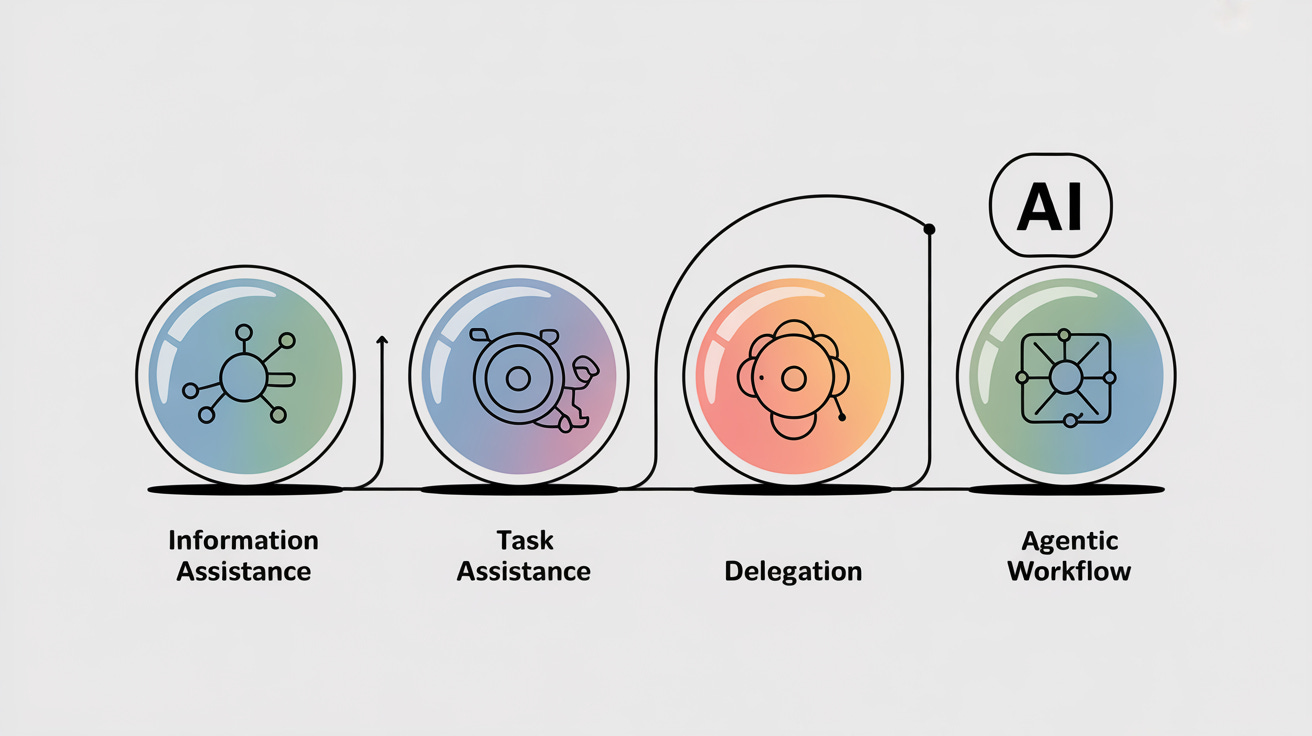
AI adoption in employees often takes four stages: information assistance, task assistance, delegation, and agentic workflow. Over 85% are still in the mode of task assistance or delegation. Real impact requires agentic workflow.
🎯 What to do:
Find your AI Champions (visible trailblazers) and Independent Explorers (self-starters who push boundaries). Give them a platform: Involve these groups in pilots, publicly highlight their successful uses (tangible wins), and set up programs where they can teach others (peer-coaching models). This scales their impact and normalizes AI use for everyone else.
Select high-value, low-risk workflows to redesign and experiment with the integration of AI. Firms need to create time and space for learning during the workday. Focus on the Organizational Adopters (who engage when tools, training, and direction are clearly established) and Passive Observers, who represent the biggest untapped potential. Provide them with visible support and incentives, like rewarding collective team performance instead of just individual “AI superstars”. Embed AI training and learning into the team’s existing meetings and daily tasks, so it feels like a natural part of the job rather than an extra assignment.
Source: The AI Adoption Puzzle: Why Usage Is Up But Impact Is Not (BCG)
Innovation Radar
1. Google and OpenAI are pushing the capabilities in knowledge work
GPT-5.2 is OpenAI’s newest frontier model series, delivering major gains in long-context reasoning, tool use, vision, coding, and professional knowledge-work performance. Google has launched a significantly upgraded Gemini Deep Research agent via the new Interactions API, giving developers access to state-of-the-art autonomous web research capabilities alongside the open-sourced DeepSearchQA benchmark.
🎯 What to do:
Pick 3-5 high-value workflows to test the capabilities of the new tools, such as due diligence, policy and regulation monitoring, operations reporting, and engineering triage.
Update risk controls for “autonomous browsing and long-running agents”. Require source allow/deny lists for sensitive topics and mandatory citation for nontrivial claims in knowledge work.
2. Additional Developments
a. Poetiq, claims its open-sourced “meta-system” that orchestrates off-the-shelf LLMs (using Gemini 3 Pro) scored 54% on ARC-AGI-2.
b. Adobe has launched free Photoshop, Acrobat, and Express integrations in ChatGPT.
c. GLM-4.6V is an open-source multimodal model family (106B and 9B Flash) with native tool/function calling.
d. GWM-1 is Runway’s real-time, interactive general world model that simulates reality frame by frame.
Grateful you’re here. If this sparked something for you, pass it along: good ideas grow when shared.